
Polymer clamp with pull strap
A thin polymer collar surrounds the pipe or hose concentrically and includes a broad inner sealing land with three shallow circumferential ribs. One end of

User Pain Point Description
To date I am using metallic ear clamps from many of my tube connections. Since the tubes are polymeric I want develop polymer clamps that can be closed by hand. They should replace common zip ties. Our polymer clamp should allow circumferential sealing to avoid any leakage. Minimum material shall be used to keep the cost low. Propose concepts.
AI Interpreted Engineering Challenge
Develop a low-load polymer clamp for manual hand closure, intended to replace common zip ties while providing circumferential sealing to prevent leakage. Design for static mechanical conditions and minimize material usage to reduce cost. Focus on a compact closure and band geometry that distributes clamping pressure evenly around the circumference without requiring tools.
AI Generated Concepts
User Selected Concept
Pull Strap Wedge Collar
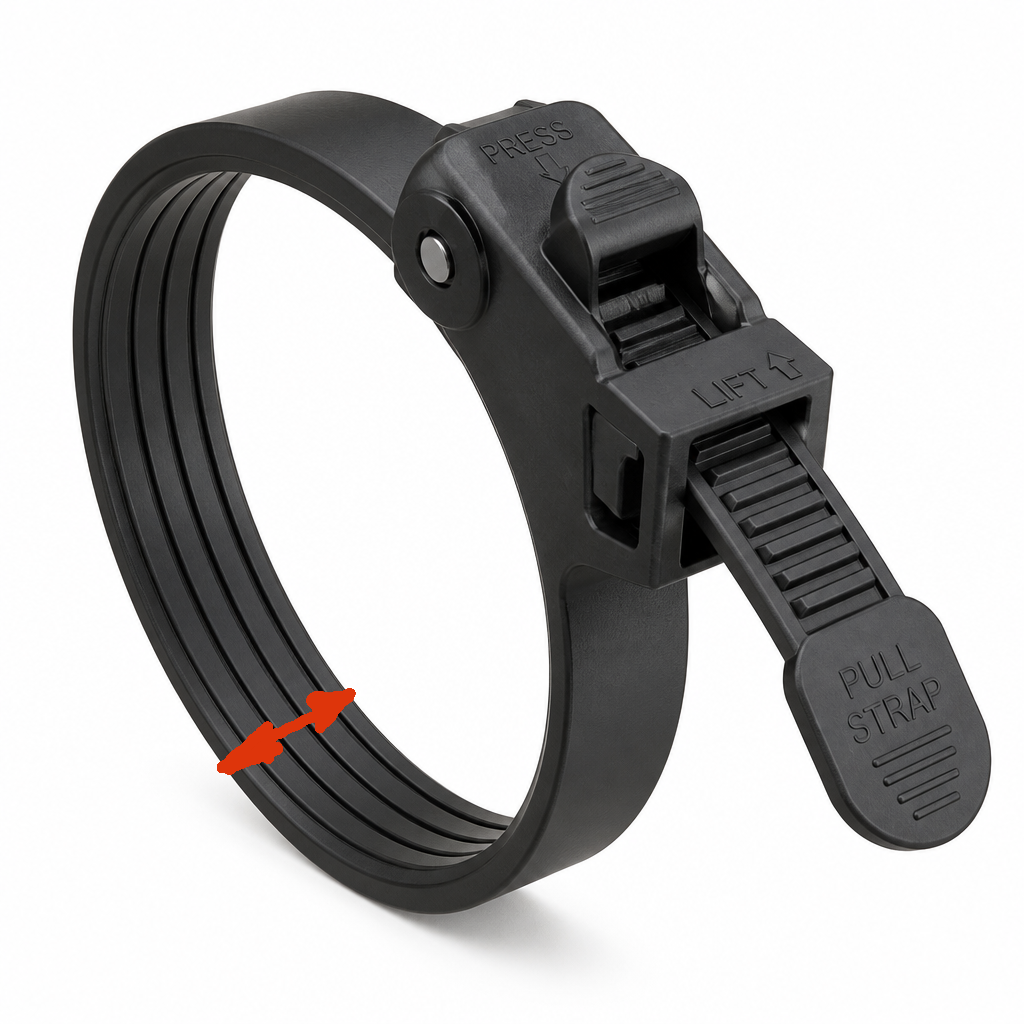
A thin polymer collar surrounds the pipe or hose concentrically and includes a broad inner sealing land with three shallow circumferential ribs. One end of the collar is fixed to a compact buckle housing, while the opposite end forms a flexible pull strap that passes through a visible rectangular entry slot in the housing. The strap slides over a smooth internal guide ramp and exits through a narrow wedge channel. Manual pulling tensions the strap around the circumference; pressing a thumb tab drives a flexible pawl downward into molded transverse strap teeth. The buckle housing sits outside the collar and is centered over the overlap region, while the strap remains tangent to the collar before entering the guide. A release tab lifts the pawl through a clearance window. The strap must not intersect the housing walls except through the defined entry slot and wedge channel; contact is permitted only at guide surfaces, pawl teeth, and sealing ribs.
Pros:
- Accommodates several hose diameter tolerances
- Familiar hand-pull tightening action
- Low-profile collar uses little polymer
Cons:
- Tooth engagement can create discrete tension steps
- Strap tail may require trimming or retention
- Not ideal for frequent adjustment cycles
Market potential: high - Resembles familiar cable-tie operation while adding sealing capability for packaging, drainage, agricultural, and appliance uses.
Profit-Margin potential: high - Molded strap and buckle can be produced as one low-material component with limited post-processing.
User Requested Concept Refinement
Refinement 1: Make the clamp band wider in the direction of the red arrow. Do not change anything else
AI Updated Prototype Geometry
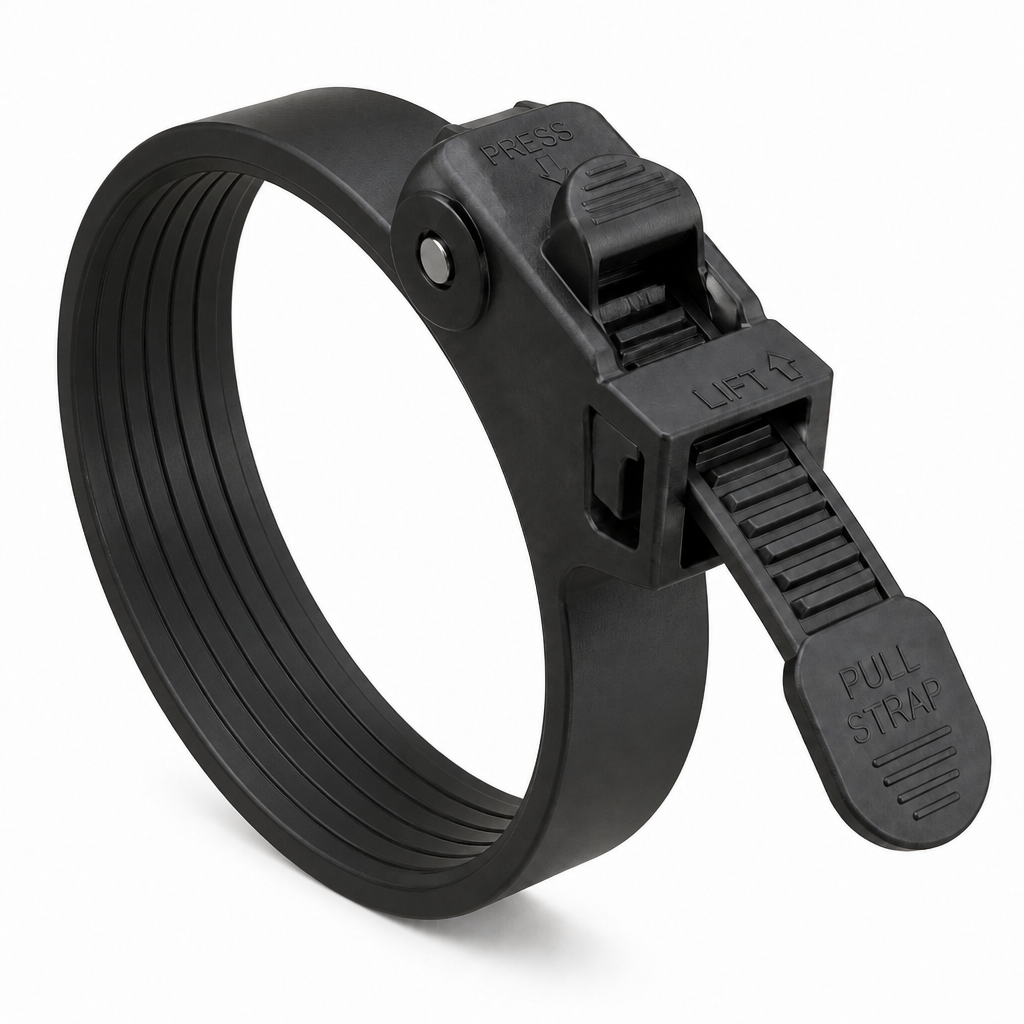
A wider thin polymer collar surrounds the pipe or hose concentrically, extending farther along the pipe direction while retaining the broad inner sealing land and three shallow circumferential ribs. One end of the widened collar is fixed to the compact buckle housing, while the opposite end forms a flexible pull strap passing through the visible rectangular entry slot. The strap slides over the smooth internal guide ramp and exits through the narrow wedge channel. The buckle housing remains outside the collar and centered over the overlap region. Pressing the thumb tab drives the flexible pawl into the transverse strap teeth, and the release tab lifts it through the clearance window. The strap contacts only the guide surfaces, pawl teeth, and sealing ribs.
AI Generated 3D-Printable STL
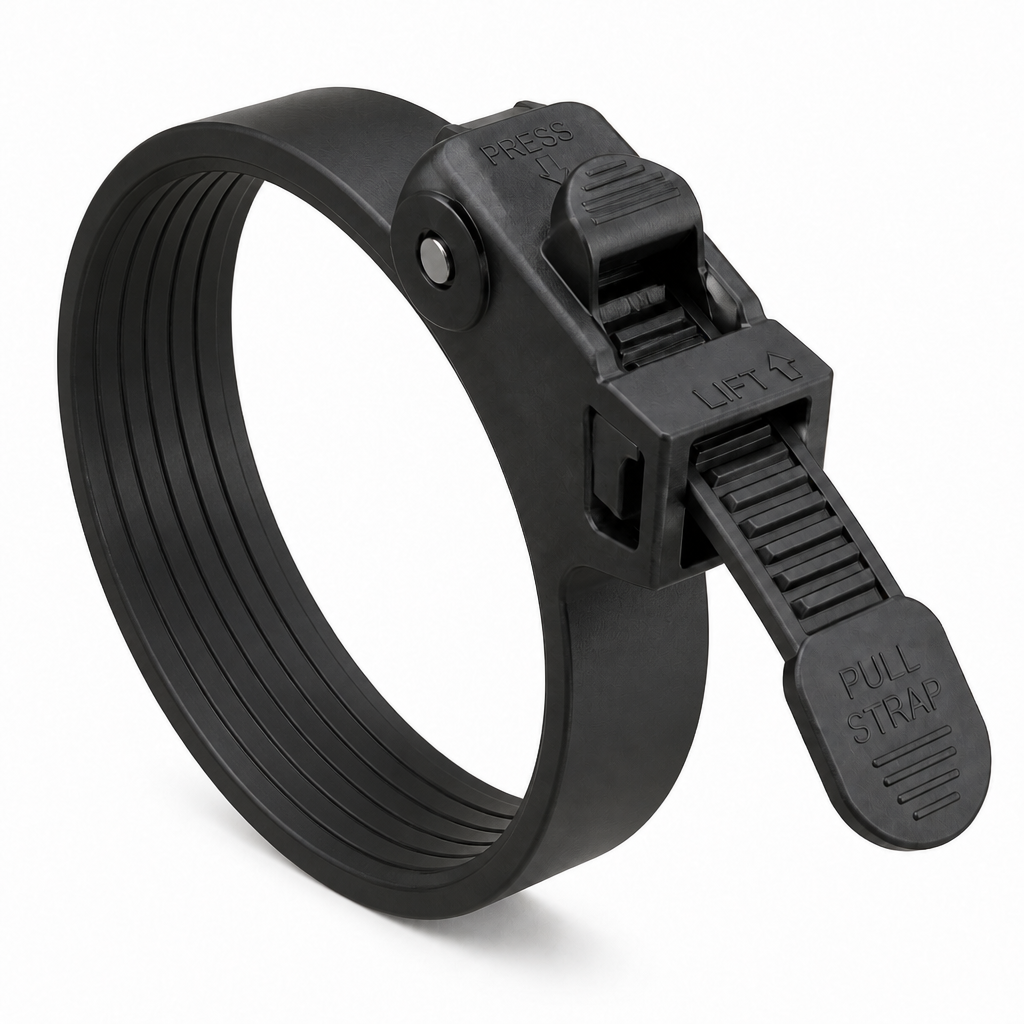
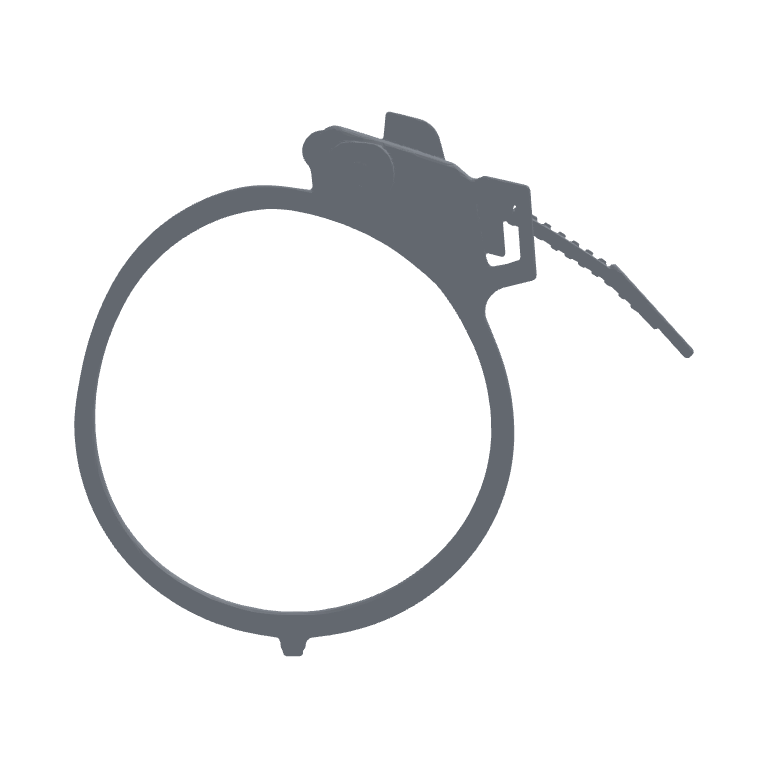
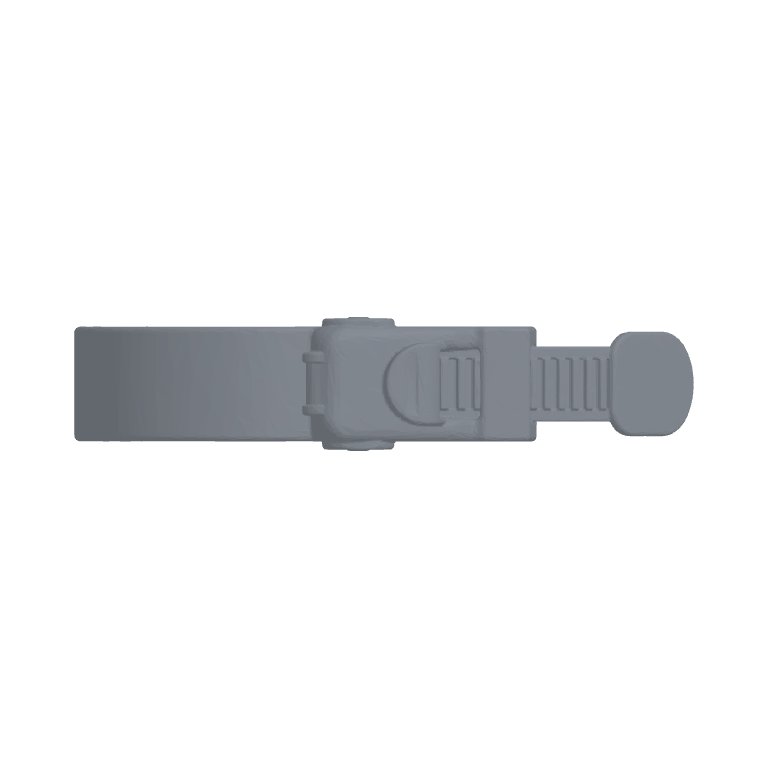
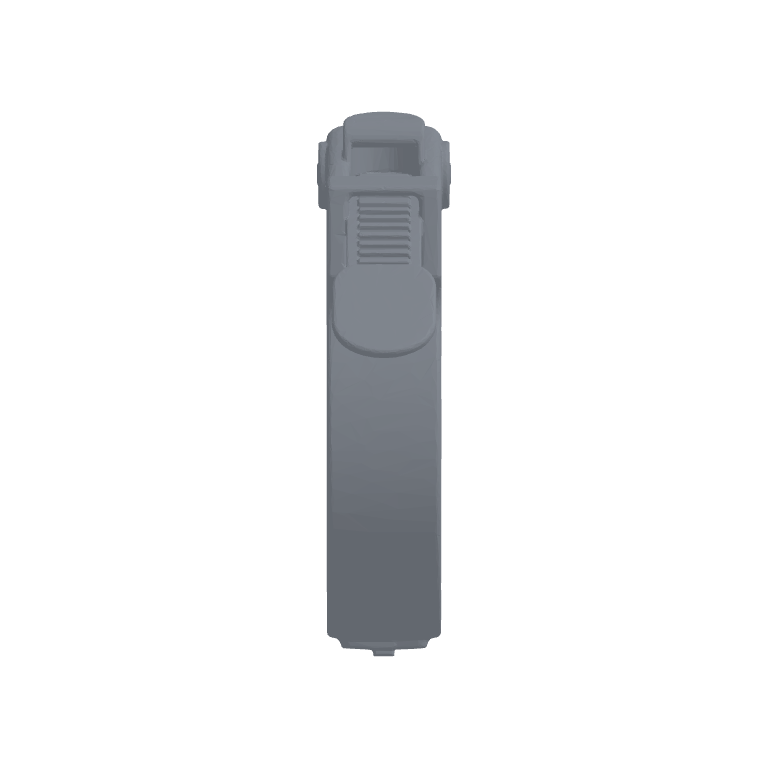
STL generation 1 used a full_image concept image as the source for a prototype mesh.
AI Generated OpenSCAD File
OpenSCAD prototype 1: wide_pull_strap_wedge_collar_simplified
Approximate bounding box: 1899.02 x 411.64 x 1669.54.
Assumptions:
- The collar center is the shared global datum at [0,0,0].
- The collar bore axis is the global Y axis, matching the supplied depth direction.
- The X axis represents product width and the Z axis represents product height.
- The supplied STL coordinate extents are used only as approximate proportional references.
Validation notes:
- All major modules are positioned from the collar-center datum, collar radii, top attachment elevation, and strap centerline.
- The collar bore remains unobstructed except for the intentionally open collar gap and external buckle overlap.
- The buckle entry slot is subtracted through the housing depth and aligns with the strap centerline.
- No STL import, final scale wrapper, target-size variable, or final assembly invocation is included.
OpenSCAD prototype 2: wide_pull_strap_wedge_collar
Approximate bounding box: 1899.02 x 411.64 x 1669.54.
Assumptions:
- The collar surrounds a hose or pipe whose longitudinal axis is the global Y axis, producing the circular XZ front silhouette.
- The measured STL bounding box is treated as coordinate units and is approximated by a 720-unit outer collar radius plus buckle and pull-strap extensions.
- The visible broad band width is represented by a 380-unit axial collar width, with the housing slightly wider at 400 units.
- The buckle sits on the upper positive-Z region of the collar and the free pull strap exits toward positive X while descending slightly in Z.
Validation notes:
- Check the Front XZ view for a circular collar centered on the origin, with buckle mass above the upper-right collar quadrant and strap extending toward positive X.
- Check the Top XY view for a consistently wide collar and a housing that is slightly wider than the collar along Y.
- Check the Right YZ view for collar axial width, centered Y-axis pivot barrels, and strap clearance through the housing entry slot.
- The collar, sealing ribs, pivot pin, housing, entry slot, pawl, and strap use shared named axes, centerlines, guard planes, and attachment points.
Engineering Assessment by the User
EDIT BEFORE PUBLISHING: add the manual engineering assessment, validation status, limitations, and conclusion.
Try AIdeator with your own engineering problem
Start from a technical pain point and build a concept package for manual review.
Try AIdeator Now Back to AIdeator home